 Objective
TODO: Acquire a "deep blue, precious mineral" and (presumably) bring it near the "encrypted" pages to decipher them and reveal their text.
This is the online version of the Lapisworks documentation.
Entries which are blurred are spoilers. Click to reveal them, but be aware that they may spoil endgame progression. Alternatively, click here to get a version with all spoilers showing.
The past is a foreign country; they do things differently there.
 Lapisworks
I have found a seemingly obscure branch of Hex Casting, "Lapisworks". All of their texts are blank, but some outsider texts about the branch say they are encrypted with a "deep blue, precious mineral".
ObjectiveTODO: Acquire a "deep blue, precious mineral" and (presumably) bring it near the "encrypted" pages to decipher them and reveal their text.
 Eureka! Lapis Lazuli
I held the deep blue mineral known as "Lapis Lazuli" near the pages of the book, and the mineral was sucked into them. I tried to get it off, but had to yank, and when I looked at the pages to check their condition, they had text on them! It seems I need to rub Lapis Lazuli on them to see their text. Let's see..
The branch of Lapisworks is all about harnessing the enchantment powers of Lapis Lazuli and with it enchanting one's own body, the items one possesses, and taking advantage of it's interaction with media. To do this, media is struck into Lapis Lazuli, forming a loosely-held-by-media material known as Amethyst Lazuli, or Amel for short. The media breaches the mineral's surface and cuts the Lapis Lazuli into many extremely small chunks then connects them like a glue. Continued..
This allows any outside media to suck out all the enchantment energy of the Lapis Lazuli by interacting with the Amel's media layer. While I have found many patterns (documented just beside this entry), some pages of the texts remain blank. Not even rubbing with Lapis Lazuli or Amel can decipher them. I suppose I will find out soon enough (or even never as the deciphering could be lost to time) and must be content with what I have now.
 Lapisworks Patterns
Transform all the Lapis Lazuli in my other hand into Amethyst Lazuli, or Amel for short. Costs one Amethyst Shards in media and in item form (taken from my inventory) each, per Lapis.
Transform all the Amethyst Lazuli in my other hand into twice as many Amethyst Shards. The Lapis turns into a fine mist which spreads quickly in the air. Excess shards spill onto the ground. Costs one shard.
Cycle through the appearances I've designed of the Amel or Amel-infused Construct (such as an Amel Ring) in my other hand. (e.g. Amel has four forms.)
The next patterns enchant various parts of my body, costing me in Amel (from any equipped trinkets, then my hands and then from my hotbar) and media. If I attempt to enchant beyond the limit, it simply acts as if I enchanted up to it. If I specify an enchantment level below the current, it disenchants to that level for zero Amel (yet retains the media cost). The enhancements provided stay with me for the rest of my life.
Pass in an entity and a number of half-hearts, and it enchants that entity's skin thus increasing their health. The Amel cost is the number given and the cost in media is twice the expended Amel.
The limit to this is 2x the entity's maximum health. Curiously, the enchanted skin also protects against Nature taking it's due, meaning it becomes impossible for Nature to take a piece of the entity's mind. Interestingly enough, old texts suggest that beyond a certain level of power mages would lose sanity, and this is how certain powerful mages were able to keep their sanity. In any case my maximum healthiness is about 20 half-hearts.
Pass in an entity and a number of half-hearts, and it enchants their fists to increase their damage per hit. One Amel and five Amethyst Shards per half-heart. Limit is 4x the norm so just 4 for me.
Enchants the given entity's feet to increase their movement speed. Costs 1x Amel and 5x Amethyst Shards. Limit is 3x the norm. The norm for me is about 1.
This speed is unwieldy for myself, so enchanting the feet of a horse would be optimal.
Enchants the given player's arms (or disenchants if given false), increasing their reach by 3 blocks and their attack range by 1. Costs 16 Amel (or 0 if disenchanting) and four shards in media to change that player. There is no customizability here.
A sidenote: it seems this spell does not extend one's arms, but rather grants the arms each a ghost-like extension which only comes out when required. Fascinating. Somewhat strangely, these two attribute enhancements given (reach and attack range respectively) count as separate for the purposes of Enhancement Prfn.
Gives me the amount the given entity has been enhanced in the given area (specified by number). The patterns before were sorted such that 0 gives max health, 1 gives attack damage and so on. Negligible media cost.
 Enchantments
I opened the texts once more, and this time they flooded my mind with useless garbage and paranoia. Their method of encryption was revealed; Hallucinated Text. The radiance in my eyes gathered and formed words, but it was too bright. My eyes hurt, I felt as if my head would explode, every corner of my body ached. I could not write. I was convinced I would shortly die.
Did these shitstains put an attempt at ending lives into some BOOK?! These cretin, these VERMIN, they would dare attack ME?! Just after MY great awakening?!-- Calm down. Calm down. I cannot afford to lose myself. I am too precious now, my mind is too precious now.
Gives the level of the specified (with ID) enchantment on the given entity for little cost and no Amel.
Like Fire Aspect but for my hands. Costs 10 Charged Amethyst 48 Amel. Has one level. ID = 0.
20 Charged Amethyst and a stack of Amel per level to bend the heavens to my will with my strikes. Three levels. ID = 1.
At the first level, this enchantment takes effect during thunder. At the second, during rain. At the third, not even clear skies will stop my fists from imbuing the wrath of the heavens unto the creatures I touch.
Cushions up to 20 blocks of fall damage per level, costing 5 Charged Amethyst and 20 Amel per level. Three levels. ID = 2.
Enchant my lungs themselves to achieve the Respiration enchantment, but twice as strong. Two levels. 1 Charged Amethyst, 10 Amel. ID = 3.
Wield the energy of an entire stack of Amel and 10 Charged Amethyst to make me hell-borne, essentially impervious to all heat. One level. ID = 4.
 Enchanted Patterns
These ancient texts recount an old and wise wizard, extremely knowledgeable of all sorcery, yet spiteful of all that crossed their path. It is told they were poor in sources of media and many came after them, but they always managed to survive. This wizard left behind a treasure trove of knowledge on their demise (collected by curious adventurers) including Enchanted Patterns. Will I ever be capable of this feat?
Frustratingly enough, the wizard attempted to burn most of them and was extremely successful, leaving only a few that were recovered by the people that defeated them. Among these few are enhanced forms of Conjure Block, some Vector patterns, Archer's Distillation, among some others. I should also note that Enchanted Patterns aren't always "better" than the original, instead sometimes they extend their functionality or specialize it.
Conjures a fragile but solid block of the specified color at the provided position (which must be within range) for two amethyst dust. More explanation on the next page.
The number states the index (starting from 0) of the dye I wish to use if they were all sorted alphabetically. All mappings:
0 - Black 1 - Blue
2 - Brown 3 - Cyan
4 - Gray 5 - Green
6 - Light Blue 7 - Light Gray
8 - Lime 9 - Magenta
10 - Orange 11 - Pink
12 - Purple 13 - Red
14 - White 15 - Yellow
Additionally, the block glows with the dye of my pigment's color and purple if no such dye exists.
Evaluates (exactly like Thoth's Gambit) the given pattern list over a hollow sphere with the given radius (non-decimal, at least 1, at most 64) around the given position.
Evaluates (exactly like Thoth's Gambit) the given pattern list over a (hollow if given True) cube-ish area from the given points A to B.
Answers the question, "is there only air there?" for negligible media cost. Vector must be in my ambit.
Negligible cost. Answers the question, "are there no opaque blocks between these points?". Both vectors must be in my ambit.
Negligible cost. Pushes whether or not the specified entity (within ambit) is able to see the specified block (also within ambit).
Returns whether the two blocks are equivalent/roughly equal (the same kind of block), so wheat seeds equals a full wheat crop. Both blocks must be within my ambit.
Returns whether the two blocks are exactly equal, so wheat seeds do NOT equal a full wheat crop. Blocks must be within my ambit.
It seems Nature searches for items for patterns like Scribe's Reflection by finding the first valid item in my hands from my other hand. This can be a problem when: e.g. I have a Focus in each hands. The next four patterns are for reading, writing, or checking any specific hand of mine (specified in order of importance-- so 0 for main, 1 for off-hand). I wonder, if I had three arms, would these support the third as well?
Specific hand version of Scribe's Reflection. Pushes the Iota stored in the Iota holder in the specified hand to the stack.
Specific hand version of Auditor's Reflection. Pushes whether the item in the specified hand can be read from or not.
Specific hand version of Scribe's Gambit. Writes the given Iota to the Iota holder in the specified hand.
Specific hand version of Assessor's Reflection. Pusher whether the item in the specified hand can be written to or not.
Charon's Gambit, if it could break through more than one layer. This pattern is useful in cases where Charon's Gambit is insufficient, however I wish not to delve into the complicated beast that is Iris' Gambit.
A oney and a twoey and a you-know-what-to-doey!
Executes the given pattern list over a list of in(or de)crementing numbers, ranging from the first argument (inclusive) to the second (exclusive) as if Thoth's Gambit were used.
Do you know the definition of insanity?
Executes the given pattern list the specified number of times. The stack on start behaves like it does for Thoth's Gambit.
Based off the Hadamard Product, this pattern multiplies the respective elements of two vectors.
Inserts the given iota into the given list before the specified index. An input of [a, b, c], 1, d would return [a, d, b, c].
Pops a list and pushes a random element of that list onto the stack.
Accelerates the given entity by the provided vector (like Impulse) for the specified amount of time (in twentieths of a second). Can be used to achieve drift/curve-shot-like effects. Costs the same as Impulse (including the subsequent cost per entity per cast) but multiplied by the time.
 Media Manipulation
I'm not sure what to make of this... I awoke in the dead of night feeling bewitched, enchanted even, by some ancient being to draw three patterns from my dream, labelling them Deposit Media, Withdraw Media, and Inner Media Purification. To my utter surprise, they actually function.
Deposits as much of the specified amount (in dust) as possible. Costs the media deposited, plus a tax of 10% of it. Can never consume my health (or any "Bottomless Phials/Trinkets") for media.
Withdraws, from the given Media Transfer Interface, into the Media-containing item in my other hand, as much of the dust specified as possible. Costs 10% of the media withdrawn.
Fetches the amount of media (in units of Amethyst Dust) contained in the given Media Transfer Interface.
A Media Transfer Interface is anything that supports media transfer. For example, if I happen upon media-containing entities (such as Phials on the ground or otherwise), media constructs (wisps, I could call them), or blocks that contain media, it is extremely likely that these two patterns may be used to interface with them.
These patterns... They feel alive, humming even. It's as if something, no someone is trapped in them. The hum is so quiet and in my head, it is as if I'm imagining it. Am I just imagining it?
 Lapisworks Mishaps
With a new branch of Hex Casting comes new mishaps. I've documented them here.
I have the correct item on me, but not enough of it. Brown particles. Upends my held items and throws them to the ground.
Perhaps real enchantments like those on my tools was what those empty pages were about? Anyway. This means the entity is already enchanted at the maximum level of this enchantment. Differing particles for each enchantment, and no punishment.
This is for when I have an incorrect item in a specific hand. Drops my held items to the ground and causes brown particles to appear, while specifying what hand caused the error.
Light blue particles. Happens when I attempt to access a trinket, however the trinket required is not equipped.
Blue particles. Happens when I attempt to interact with a trinket, however it doesn't support the interaction required (like reading, writing, etc.).
Light blue particles. If I attempt to cast an Amethyst Ritual or One-time Ritual or any other kind of ritual-specific pattern outside of one, my entire hotbar is upended and poured onto the ground.
 Imbuement
Apparently some of the materials of this world have differing interactions with media, including Amel. Let's see..
Imbue AmelThe ancient "Lapisworkers" would use this often. Imbue the item in my hand with the specified amount of Amel, with no waste like the Enchant X spells. Costs 2x the amount of Amel being infused, in dust.
It draws Amel firstly from anything I have equipped, then from my hands and then from my hotbar. The number argument I provide limits it from being able to find or draw any more Amel than that.
Besides turning one item into another, this spell can also be used to enchant some things instead. For example: one use I've found is to enchant Enchanted Books that have only one enchantment. It increases the level of the lone enchantment on the book by 1 for 20 * previous level Amel and about five charged crystals of Amethyst.
For one dust, tries to disenchant the infused item in my hand. If the item has multiple methods to make it then it the Amel has corroded it's original essence, so this spell disintegrates the item into the least Amel that makes it up.
 Casting Rings
One of the main limitations that has kept me from making a ring to cast with is that the ring would be much too small to even work. However, now that I'm reviewing these texts I can see a path through. Some materials apparently have special interactions with media. Two examples of such materials are documented on the next page.
Diamond focuses media (due to its "chemical structure" (what is that?)) while Gold to media (and Enchantment Energy) is like air, letting it freely conduct. The "Lapisworkers" of old took these materials and combined them (with Amel at times) to make many a great constructs, but many of those have been lost to time. However I can easily create my own.


Diamond to focus the media, Gold to not block the flow, and Amel to attract. I can Use Casting Ring to open the casting grid when it is equipped.

Praise be to Mold Amel.
 Imbuing Staves
I believe that actual staves would stand to gain from Amel Infusion. These staves (due to being large) would need more Amel than, say, the Amel Ring but would create a more precise staff. What of incomplete infusion, however?
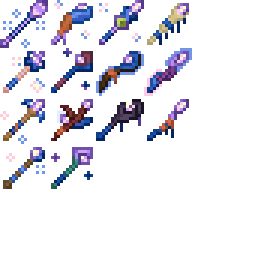
My own renditions of possible incomplete staves.
Staves that did not have the amount of Amel required to fully transform have Amel deeply rooted in their structure but not enough to stand against the power draw of the Amel for very long. The product is inefficient, leaky (and thus not very long-lasting) but also more precise (bigger hex grid) than full infusion.

The fully infused staff is less precise than the incomplete ones (has a smaller hex grid boost) but actually lasts. I suppose there is some merit, then, to having an incomplete staff and constantly feeding it low amounts of Amel so it does not decay. It takes about 10 Amel to make this.
 Imbuing Swords
The Amel Rings started my brain walking. The staves got it running. Now I can't stop, it's simply too enjoyable to invent my own items. This time I got curious about what kinds of swords could be made, so I designed some and documented them here. Each takes 48 Amel to make (with no incomplete version) and are repaired with Amel above 90% durability, but the normal material when below that.
Infusing Amel into a Diamond gives it the ability to sacrifice its durability to shoot out extremely quick and focused jets of media that deal as much damage as the sword itself, when I squeeze the handle. This has a range of 10 blocks. I should infuse the Amel through the top, to sharpen it.

Iron's interaction with Amethyst Lazuli Infusion seems to be that the Amethyst Lazuli reinforces it to twice as much durability, allowing it to be feasibly used as a shield. Additionally attempting to block with it momentarily charges up the Amel like with the Amel-Infused Diamond Sword for a quarter of a second, and if hit at that point the Amel lashes out. I guess I could call this ability "parrying".
The Amel lashes out towards the other person and absorbs some pieces gaining 20 "points" of durability. It also hits the enemy with half the power of the sword (launching them away from me as well). If their tool breaks, it steals every piece, gaining 100 "points" instead of just 20. Additonally the enemy feels their tool was hit so hard they have to make sure it's not completely broken for a second or two, almost always.
The Amel has enough energy that it can even withstand an axe hit and go straight for its handle, making the enemy tool take 100 "points" of damage instead of just 20. However if I fail to parry the axe my tool takes 20 "points" of damage and I get flung away. Additionally the Amel on my sword is rendered useless for a second due to suffering so much damage while unprepared for it.

Gold is a conductor, so Amel can practically phase right through in imbuement. Amel is a natural toxin to most living beings so I can infuse it and make the blade "tipped", essentially, so it doesn't slide right off. Hitting entities with this makes the Amel lash out and go into them (destroying a relatively major piece of the sword as well), poisoning them for about ten seconds. A glass cannon.
 Simple Artificial Minds
When I first read of the mind and that it produces trace amounts of media, I wondered, "is it possible to create a mind..?" Now after my experience with Amel imbuement, I think it is. In my experience a heap of media does not on its own start thinking, which can be explained by the fact media is merely the energy of thought. The energy must, however, be moved and used to think.
If I were to make a machine that tugs at and copies the flow of media in other organisms, such a machine would surely, with time, gain a mind. For this purpose I believe villagers are most efficient as they are not outright nearly braindead but also not truly sapient. The resultant mind will probably be concious, sapient and will bear emotions (be sentient).


The Amel will let the machine eat bits and pieces of villager minds, taking "snapshots" of the flow of media within. A Diamond should focus it enough to mimic the precision of natural minds. The Charged Amethyst will hold the mind.
This contraption can tug at the minds of three random waking villagers at most 5 blocks away at once, filling in 20 minutes from just one. A waking villager is exhausted after 4 minutes (and heals in the same amount of time when not near this machine). Sleeping villagers, if selected, aren't able to be consumed from again for 20 minutes but fill 15% of the mind container instantly.
These Great Spells elude me so. There must be a better way than delving into old ruins to rediscover them. If the old ones discovered them on their own, so can I! To that end, I have found a way to directly ask Nature for the stroke order, however it only returns a torrent of information that must be sieved through by someone, or something.. Expendable. The spell eats over a quarter of the mind regardless of success. I can't imagine this experience not being painful.Should this bother me?
Sieves the torrent of information using the (full) artificial mind at the given position. 3/5 chance of replacing the pattern in my other hand with one of the correct stroke order.
Pushes the percentage filled of the mind container at the given position to the stack.
Absorbs the entirety of the mind within the container into the rechargeable item in my other hand. If there is any extra, it is discarded. A full container yields one Charged Amethyst.
This.. This doesn't feel right. I gained the ability to make fully conscious and perhaps even sentient or sapient beings, and my first ideas were to KILL them for meagre amounts of media, like sheep. I shouldn't be doing this. They're more than just sheep, aren't they?
Are they more? Should I care?
 Jump Slate
I have learned never to open those texts that require a broken mind again. They disturb my psyche tremendously, likely due to some password being required that had since been lost to time. My psyche. They touched my sanity. They tried to hurt me at my pinnacle. How dare they? HOW DARE THEY?! Stop. Keep calm. Focus. Move on. History will have taught them their error in their demise.
The constructs made of slates that were previously lost to time until I recovered them, also known as Spell Circles, are truly glorious. I adore them. I can do so much with them. However.. As much as I may love my new playthings they are not perfect so. They are grand indeed! But sometimes, I feel they are too grand. Their color clashes with the aesthetics I desire. The directrices, impeti, they look so hideous in certain builds! It pains me so! But.. With Amel Infusion I can fix this.
Amel reigns supreme when it comes to attracting and integrating into media, using it and enchanting constructs. An enchanted slate could be produced intricately and in such a manner it turns into a media accelerator not unlike my Amel Ring. It can also be amplified by media (dynamically!) to push it further, bypassing slates. This effect, I'll coin "jumping slates". My original creation. Mine. My marvellous invention, it requires only 20 pieces of Amel and has a range of 100 blocks!
It attempts to pop an number that's not 0 or 1 off the top of the stack and take 2.5 times that in dust from the circle to jump that many blocks. Behold it's marvel, however: if it fails, it lets the flow pass straight through like it were a junction. Nothing ever escapes to the sides. What if it finds a negative number? Even better, it jumps backwards and the leftover momentum makes the Spell Circle work in reverse.

Spell Circles were revealed to ME. To ME. And I have improved them. That's why they were revealed to ME.
While the Shepherd Directrix may be the most easy-to-use for making loops, it looks... unwieldy, to say the least. I desire something more pretty. A Jump Slate that reverses it's direction after the jump. As an Impetus can push the flow of media, I deduce a Simple Mind would be able to do much the same. Imbuing a Simple Mind into a Jump Slate should do. I'll call my invention: the Rebound Slate, as it always directs the flow of media back to itself post-jump, except when it fails.

Through and through and right back around. The thought of that disturbs me yet keeps me sane.
 Amel Storage
My new tools are fun to play around with, and the Amel being able to be drawn from the hotbar is also convenient. However.. I find that some things in this field require a rather inconvenient amount of Amel to carry. For example: the partially-infused staves, while they grant me a larger hex grid, need constant repairing with Amel. Another example is the Enchant X patterns, which require a bunch of Amel as well. They make my pockets ever fuller. I cannot make much space for other things as my hands and my hotbar are unfortunately full. Indeed, I must acquire a solution.
And a solution I have acquired. By infusing just 5 pieces of Amel into an ordinary glass bottle, I can turn it into an Amel Jar which can store 4 stacks of Amel. This Jar can be worn on my belt (to prioritize it as the first source to draw Amel from), or held in my hand. I can Use Item/Place Block with Amel in the other hand to deposit it, and if I sneak while doing it I can withdraw up to a stack of Amel at a time into the other hand.

Works the same way but stores 16 stacks and cannot be put on my belt due to it's unwieldiness. It can, however, be left in my hotbar and will still function.
 Trinkets
The old Lapisworkers seemed to have a fondness for making Trinkets! Some of their scrolls contain mention of using these as gifts to other people to do many things, including showing appreciation, comforting during times of hardship, etcetera. Perhaps that is why they chose materials a little on the expensive side.
I will document any mentions of these trinkets I find here.

A Focus Necklace, also called an Amulet Of Holding (names useable interchangeably) is a trinket that one wears around their neck. It can be interacted with like a Focus via Scribe's Reflection/Gambit, but it also has it's own patterns that were discovered shortly after it's creation, which allow me to read and write to it while I'm wearing it.


I believe the Amel is put there to allow the easy access to the focus by attracting media towards it.
Reads the iota from the necklace I'm wearing. Mishaps if there is no readable necklace available. (Drawing aid: the pattern is a line into almost a triangle, then a counterclockwise circle much like Scribe's Reflection.)
Writes the iota to the necklace I'm wearing. Mishaps if there is no writable necklace available. (Drawing aid: the pattern is a line into almost a triangle, then a clockwise circle much like Scribe's Gambit.)

I should note that Mold Amel destroys the iota contained within.
 Media Condensing Unit
My options for storing media are rather... Untidy and insufficient. Any media not in Phials must be stored in chests, in items. These items cannot be transported easily either, so I cannot have more than one base of operations lest I set up a convoluted system. Therefore I, one chosen, have invented the Media Condensing Unit. I must use Craft Phial on it's base to construct it.

A thin layer of slates covering the battery, with a media attracting substance and a dust-provided interface for interaction on top.
It's become clear to me now that I've made this. They were clearly expecting my Awakening, and my work to advance the art of Hexcasting! The reason...? Deposit Media and Withdraw Media work on these condensing units as well! Moreover, even more patterns have been revealed to me now, DOUBTLESS proof!
A Phianglement is a link between two phiangleable blocks. It's a a link such that when one is deposited into, the overflow collects in the other, and when one is withdrawn from, underflow is fulfilled by the other. A chain or even an interconnected network of units can be set up, however the amount of links for a single condenser can be no more than five. Links cost nothing to maintain once set up.
Phiangles two phiangleables. Costs a flat three Charged Amethyst, and a scalable one Amel per 32 blocks of distance, with a minimum of one.
Dephiangles two phiangleables, erasing the link between them. Costs three Charged Amethyst. I can cast this when I wish not to break the block, due to having other links for example.
To my delight, it seems that the Phianglement granted to me by Them seems to function with Impeti as well! However, they can only have one Phianglement at any time, and they behave as leeches; they can only withdraw from the network to fulfill their own costs and nothing more, meaning they cannot be deposited into, nor withdrawn from. The advantage here is that my Impeti can finally have a centralized media storage!
Returns the positions the phiangleable at the specified position (within ambit) is phiangled to. Free.
 Geode Dowser
"Aye, the compass doesn't point North. But we're not trying to find North, are we?!"
This one is simple. Imbuing 10 Amel into a Compass crafts a Geode Dowser. On use it consumes one Amethyst Dust and constructs a brief, sensitive field of Media to detect the nearest Budding Amethyst in a 200x200x200 cuboid of blocks centered on me.
It then spawns a burst of particles pointing to it, with the color indicating the distance. Blue means it's within 16 blocks, light blue means it's within 32, purple is 48, pink is 64, orange is 80, red is 96 and any more makes the particles black.
 Enchanted Brewery
Enchanting a Brewing Stand with ten pieces of Amel makes an Enchanted Brewery. It consumes 25% more Blaze Dust than the Brewing Stand and requires one Amethyst Dust per brew in exchange for brewing potions twice as fast. In the future, due to how strongly the ingredients are shoved into potions, I may unlock more brewing possibilities with this than a regular Brewing Stand.
 Amethyst Rituals
Alternative casting methods that do not require me... This could prove to be quite useful.
ChalkThose grand constructs lost to time that the Slates were used in are said to be able to cast by themselves. I for one cannot fathom how such things would function-- it's components are simply rock! If not gain direct access, I may be able to imitate it. Simply putting the flow of media through patterns is enough, right? Then all I need to do is conduct media. The form I've decided for this is Chalk.

Only on hard surfaces such as stone. Placed once it is a simple conductor, placed twice it gains space for up to five patterns. I'll dub these chalk constructs.. Amethyst Rituals.
In the future, I may find that the chalk is much too small for the pattern I desire on it, or that the pattern in question is much too complicated for me to draw. In such cases, an Amethyst Stamp to read from with Scribe's Reflection, write on with Scribe's Gambit, and then to magically stamp my patterns onto the chalk would be ideal.

I quite like the look of this one.
Amethyst Rituals do not have any ambit around them by default. In some cases they may have ambit elsewhere as well, but their main source of ambit is Amethyst Tuning. In summary, I may tune Tuneable Amethyst to an iota, and any ritual tuned to the same iota will have (at minimum two blocks of) ambit around that shard. The method of tuning differs from type to type of ritual.

Like a tuned glass, it vibrates when hit with the waves of a matching frequency from an Amethyst Ritual.
Tunes the Tuneable Amethyst at the specified position (within range) to the specified iota. Costs a piece of Charged Amethyst and one Amel.
Returns the iota the Tuneable Amethyst at the specified position (within range) is tuned to.
The ambit Tuneable Amethyst provides around itself is at minimum two blocks, however depositing media into it can enhance that to up to sixteen. The ambit provided is the square root of the media contained within. Deposit Media and Withdraw Media work perfectly for this.
 One-time Rituals
If I Use Item/Place Block some Amethyst Chalk with a source of media in the other hand, it starts a One-time Ritual with all that media. One-time Rituals are single-use and very fast, destroying all chalk they traverse over and moving at twenty segments per second. One-time Rituals may have many properties hot-swapped with the following spells.Casting these patterns outside of a One-time Ritual will fail rather spectacularly.
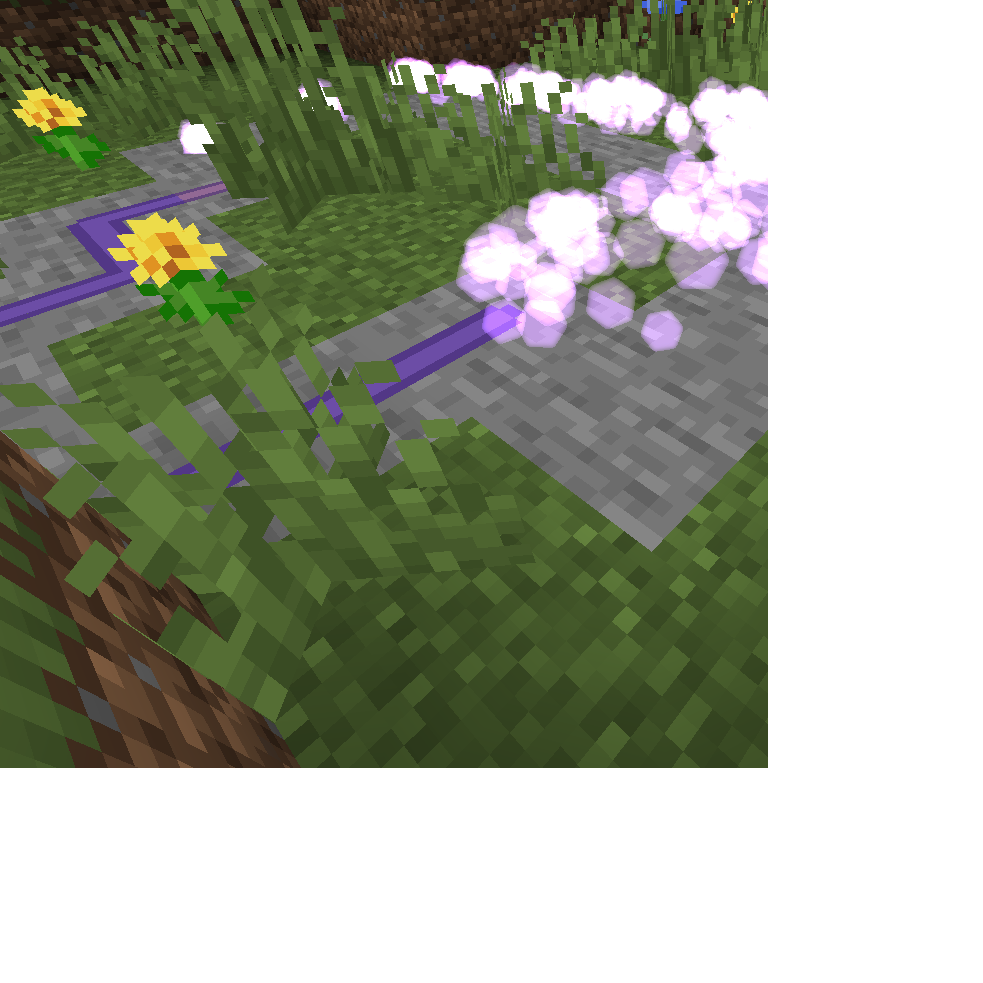
An example of a One-time Ritual.
 Multi-use Rituals
A Multi-use Ritual consists of all the parts of a One-time Ritual and one extra. A starter. A stable starting block to control the ritual and prevent the media from burning up all the chalk in it's path. I may call it, a Ritus (pronounced "right-us").

Any ritual may pass over it as if it were chalk, and One-time Rituals do not burn it up when they do.
If Use Item/Place Block it with some Amel in my hand (or in an Amel Jar in my hand, or equipped on me if my hand is empty), it activates, starting up the Multi-use Ritual (in the direction I was facing if possible). If I Use Item/Place Block it with a readable iota holder (such as a Focus) in my hand, it tunes itself (and any ritual it's executing) to the iota within. Due to the degree of control of the Ritus, it's rituals cast as me, but have no ambit around me like One-time Rituals do.
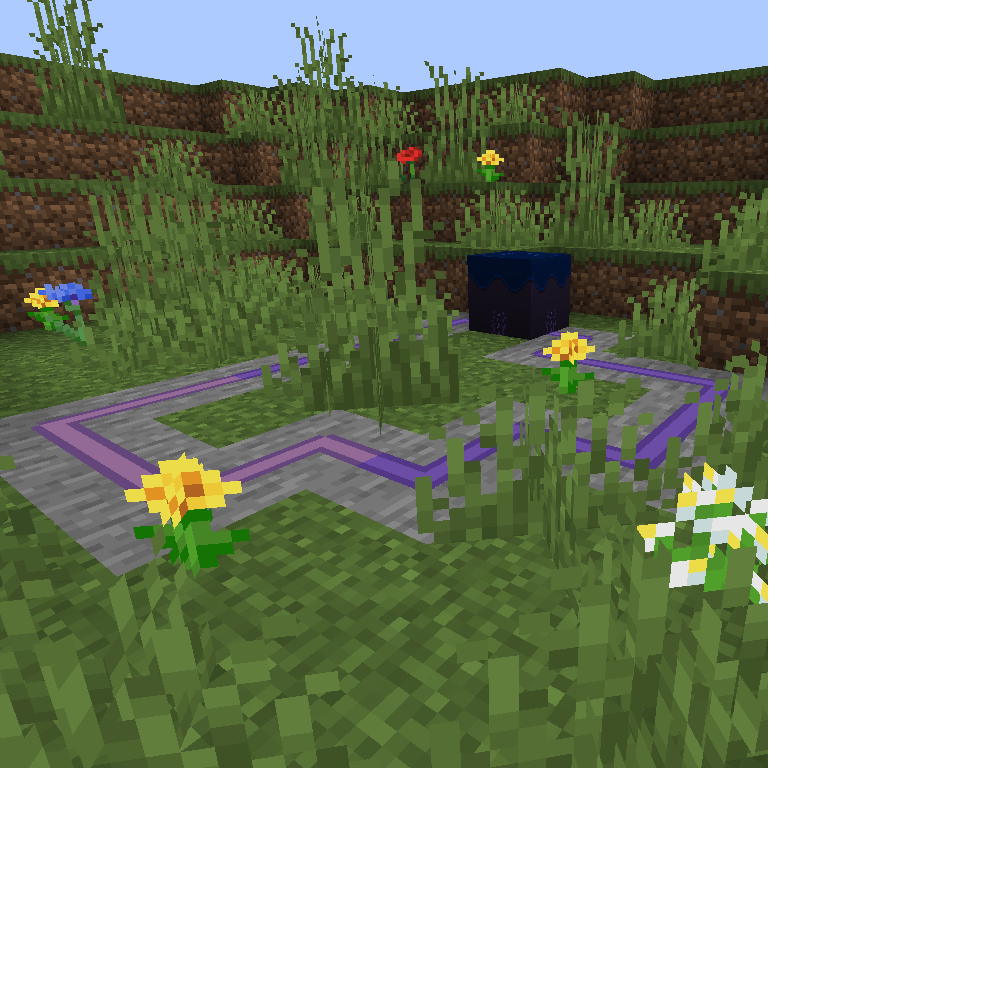
An example of a Multi-use Ritual.
 Grand Rituals
A Grand Ritual is a 3x3 multi-block ritual on any surface (such as a wall, the ceiling, or the floor). I can create one if I Use Item/Place Block chalk on the middle of a 3x3 collection of chalk (which have space for patterns on them). To write a pattern, I must stamp one onto it.
To activate it, I must Use Item/Place Block the Grand Ritual with a clear hand. It will prepare then cast a pattern for only half of it's usual cost, using the conditions (stack, etcetera) of my staff. If I Use Item/Place Block it with Amel, the Grand Ritual disappears after casting.
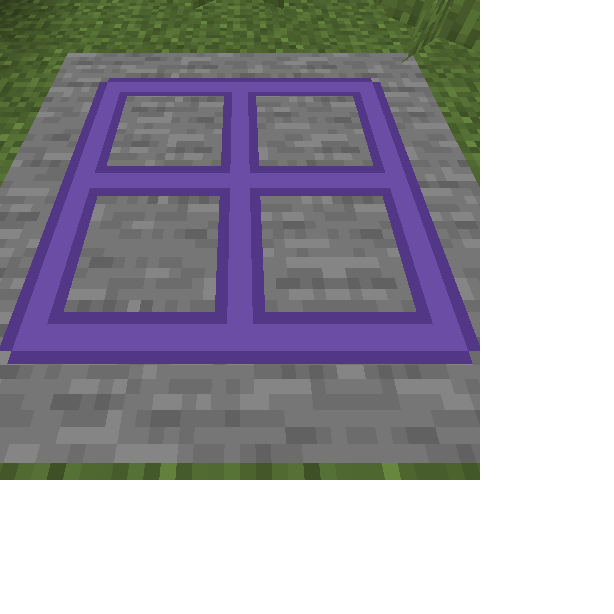
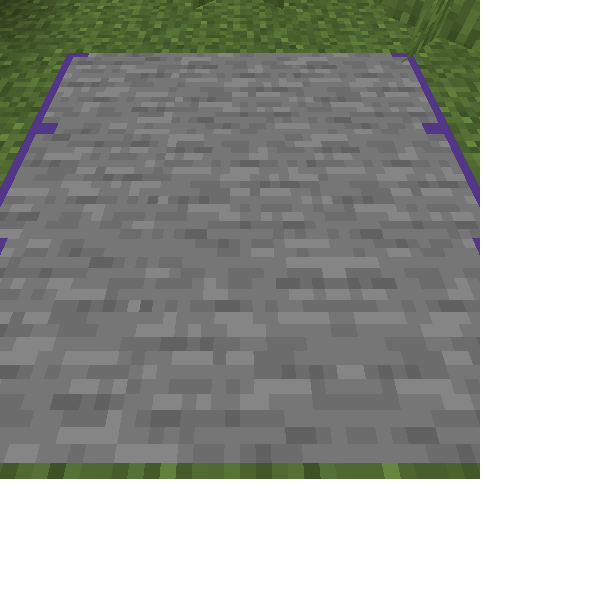
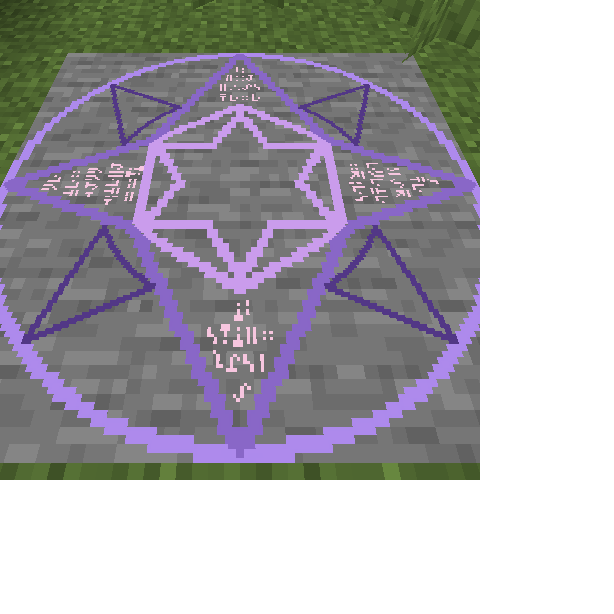
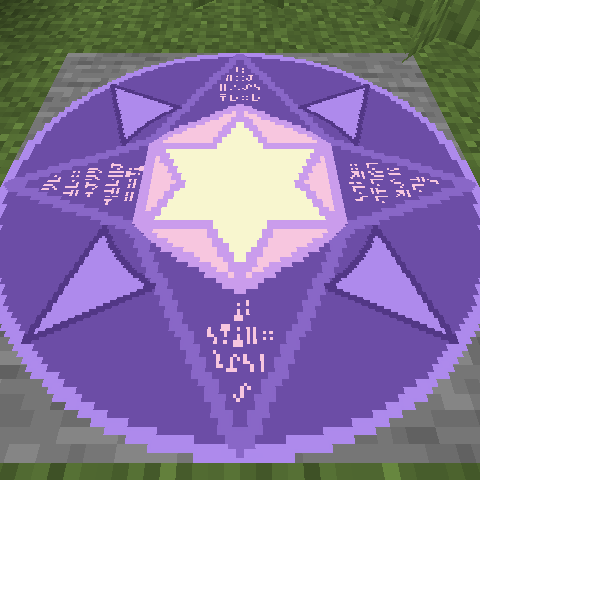
How to create a Grand Ritual. I may swap between the third and fourth via Use Item/Place Block with Chalk.
 The Wizard's Spells
Some intellectuals and/or adventurers saved the old wizard's diaries. I've begun to divine some of the wizard's knowledge from these ancient tomes.
The Ancient WizardI have found rumour of an old, knowledgeable wizard that has done much evil and staved off the hordes of vigilantism, yet always had low media reserves. I've read tale that while they attempted to burn most of their scriptures near their demise, some adventurers and intellectuals had managed to save some of them from the grand fire.
Based off of this information I predict they may have buried the knowledge away or put it in the strongholds I've read of, such as pyramids in the desert, brick structures underground, etcetera.
 Enchanted Sentinel
Whilst being hunted by a particularly strong group of 30-40 people consisting of professional hitmen or assassins, bounty hunters, and other mages looking to vanquish them, the mage had escaped into a castle. They needed a way to be able to deal with all of them from a huge distance or from a few floors up. Greater Sentinel had a small area, thus small corridors would be suspicious. So out of desperation, they looked to their Amel to "enchant" the pattern.
Summons an enchanted version of the Greater Sentinel at the given position (which must be within 32 blocks around me) and the given ambit (which can be from 1-64). Costs 5 amethyst dust to summon.
This Enchanted Sentinel has much more media than a Greater Sentinel, but has chains imposed on it that make its existence dependent on me. It must always be in MY ambit (a Greater Sentinel's ambit is much too weak) or else it falls apart. It's still intangible, but it emanates particles visible to everyone. I perceive the particles as well as a media-dense being which looks like some dark purple, unnaturally twisting geometric shape.
The wizard wrote it was created by forcing Amel into the original pattern and molding it violently, shaping the media within to their will. The result is a "4-dimensional spinning hypercube projected as a tesseract!" (what does that even mean??) which has some form of feeling and awareness. It knows it's chained to it's user, forced to follow their whims due to being dependent on their media.
Peacefully put my Enchanted Sentinel to rest for a negligible amount of media, letting it rest for a time. Perhaps the ethical option, considering "falling apart" may not be the most painless.
 Imbue Mind
Most of the pages are burned, and only the pattern with it's documentation and it's uses remain. Any questions like "they had their own form of Simple Mind Containers?", "Why?", etc. will probably have to be speculated about by me. Unfortunate.. In any case, I've documented the pattern on the next page and then it's uses on the pages after it.
Takes the location of a block and then the location of a full Simple Mind Container, and imbues the mind into it for five Charged Amethyst. Déjà Vu...
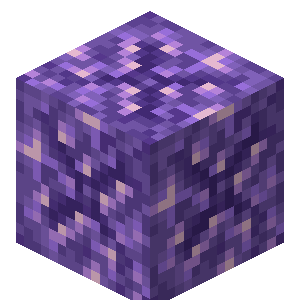
An Amethyst Block, when imbued with a simple mind, turns into a Budding Amethyst block. Nothing too special, really. But I do wonder, if minds can be put into these blocks to make more amethyst, where did all the amethyst that's already here in this world come from?

"A mind so simple can be imbued into functional blocks with great ease and without stripping away unnecessary parts." I believe this line refers to the Jukebox on the same page (and others on other pages), which can be turned into a Live Jukebox. A Live Jukebox can be taught to play notes at a frequency, and then hit to play those notes.
Teach the Live Jukebox at that location (which must be within ambit) these notes (a list of nums 0-24) at this frequency (0-20) for a shard of media. After being hit via Use, it plays the notes like an automatic Note Block.
Divines from the specified Live Jukebox (within ambit) it's properties, and then returns a list of two elements. The first being the notes it plays, and the second being the frequency it plays them at. Free.

This part has the same encryption that the Enchantments did, but it doesn't hurt. I suppose it'd be annoying to go insane when reading your own notes. Anyway, imbuing a Simple Mind into an Empty Impetus (with five Amel) turns it into a Simple Impetus. It (the impetus) always casts as me, and (due to casting as a reflex) even starts off with half the usual max circle speed. Continued...
However, this speed is fixed and cannot increase any higher as a trade-off, making it just enough to react to a spell. Moreover, it also only casts when any valid pattern or the pattern it's listening for is cast (within 32 blocks of it). Teaching it a pattern to listen for will make it only listen for that pattern, and not trigger upon any other. Also, any pattern it's been taught to listen for will not mishap if it doesn't exist, given it was cast within range of the impetus.
Teach the Simple Impetus at the provided coordinates (which must be within ambit) the provided pattern for two dust. The Simple Impetus will not remember this pattern when broken.
Simple Impeti are pretty gullible. Returns the pattern the Simple Impetus at the given location (which must be within ambit) is listening for, or null if it's not listening for any particular pattern. Free.
With my Awakening, I have begun seeing text where it isn't (an example being Enchantments). The ancient wizard does not have put any warding hexes in their encrypted notes (unlike the OTHERS) so I can read them freely and without an existential crisis. These pages seem to have a lot of residual media clinging to them, allowing me to read off the burnt parts.
Takes an entity and the location of a full Simple Mind Container, and imbues the mind into the entity.
I can imbue a Simple Mind into a villager that has lost possession of it's own mind (like via Flay Mind) to grant it a new one. A Simple Mind has varied experience across all types of villagers, so in a villager it is quite like a jack of all trades (shortened to Jack or Jacqueline if I prefer). These villagers start with 2-3 levels of experience already in every profession.
 Hastenature
This one was created when the wizard was extremely adept at pattern infusions with Amel, their final days. They were a master of it, to the point their infusion created extra patterns, or byproducts. The main pattern here was one that was supposed to be one that'd age enemies to death, a horrifying spell the pattern for which - for better or for worse - was burned.
Takes a block position and a positive number, and ages the block (or how I call it, induces a random tick) there that many times. Costs 1 shard per age-up, but 3.5 if the target is Budding Amethyst.
 Indigan Lapidary
There is not much written here, besides the following:
"He flayed himself into it."
Given at least two pieces of Lapis Lazuli in the other hand, converts Lapis Lazuli to Amethyst Shards at a conversion rate of 2:1. Overflow of Lapis is wasted.
This spell apparently uses the Lapis Lazuli provided to punch a hole through space. This hole leads to a dimension of pure, congested thought that is dangerous to exist in. It then takes two Amethyst Shard worth in media from the dimension, crystallizing one while using the other to replenish it's cost. Strangely, Nature refuses to make this pattern cost anything.
 Lapixtended
Many pretty additions to my craft, but there's more.
 Presence
The idea I almost had was completed in my dreams. And the result? So many staves! So pretty! I must model incomplete Amel-infused versions of all of them!
 Amel Orb
The unique energy that entities give off I cannot replicate. However, Amethyst Lazuli attracts media very well, so if I were to turn it into dust (or even more fine particulates, or maybe an enchanted link between two places) I could emulate it instead. Thus, the Amel-tuned Orb, made from infusing 10 Amel into a Drawing Orb.
It's a device which uses up 10 Amel (from my hands or an Amel Jar on me) to write my current head position to the orb. This position will aways stay within my ambit, if the orb is in my grasp. The line can stretch across truly vast distances to provide me about three blocks of ambit around the set position as long as the orb is in my hand. I should note that the Amel may never be refunded.
 Lapse
LapseI wonder, would something as intangible as a wisp be capable of being enchanted?
PresenceThe Lapisworkers of old mention these "slipways" in their texts in passing, along with many remarks of "it is not a place we can interfere" due to a society that held a monopoly over these in the past. It seems I must be the first Lapisworker to innovate in this field, then.
Wisp HandlingLong has wisps being unable to hold items irritated me. Fortunately I have discovered this Enchanted Spell which allows me to let wisps handle items.
Swaps the item the provided wisp (that I must own) is holding and the provided item. Costs two and a half dust.
Takes the item in the provided wisp (that I must own)'s offhand and lets it go into the world at the wisp's position. Costs two and a half dust.
While I was working on extensions to wisp functionality, I found that the Media Manipulation spells function the same for a wisp. Particularly strangely, Deposit Media considers wisps a valid target for depositing and Withdraw Media recharges the wisp instead of any media holder the wisp is holding, and if targeting a wisp, the caster must own that wisp or suffer a mishap.
Wisp CreationI've noticed Imbue Mind can shape the Simple Mind into many things before imbuing it somewhere. If I can truly shape the Simple Mind into anything, does that mean imbuing a Simple Mind into the air will spawn one of the wisps that usually emanate from slipways?
Perhaps I can take advantage of this to get more media out of the Simple Minds.
To Rip Open a SlipwayThe Slipways. They must lead somewhere. wisps do not manifest from thin air. Yet no matter what I do, the slipways won't let me through. But I WILL find a way beyond them. If the slipways will continue to deny me access, I will rip them open myself, By getting Simple Minds to do my bidding. I will write further when the tools at my disposal allow me to progress further in this matter.
Imbue Mind can do it. I KNOW so. By instructing the Simple Mind to open the Slipway and enchanting it with the power of 48 Amel, the Simple Mind exerts an unimaginable amount of force upon the slipway, tearing the very fabric of space open! The world will marvel at my feat! Now, all that is left is to realize it by attempting to imbue a Simple Mind into a slipway. I must note that this will take a lot of space.
SHATTERED. The slipway was forced open with the greatest amount of force I can muster, and the fabric of space made a deafening sound as it was torn apart. I felt a powerful gust of media that pushed away all living beings except for allays. Marvelous. However.. As I tried to enter the hole in space, I found I could not travel through it. DAMN IT, DAMN IT, DAMN IT, LET ME THROUGH I DESERVE ENTRY!-- Calm down. Calm down. I cannot risk losing myself now. I am too valuable.
There must be another way then, one I will discover soon. In any case, the Rift still has other properties. For one, the media expelled from it is so vast in magnitude, it pushes away all non-allay living entities. It also makes many, many more wisps than a regular slipway, which I may find useful as a source of media.
 Lexical
A hunt for a legendary item that holds a mythical spirit may reveal other things as well.
PresenceThe myth has evolved into rumor, however I do not see a way Lapisworks can interact with these Genies. However, the hexical changes taking shape in my world recently aren't such an exception.
 Rod and Cradle
The Lightning Rod Staff looks like I put things other than a full Amethyst Block in it's cradle, but alas. However, I may construct a separate cradle and use Amel to focus media and hold an item in place. Placed upon the rod, the cradle gives off an impression of a wand. My hexes are also able to access the item within via (for example) Scout's Distillation, and the Amel used in it's creation seems to make the "hitbox" of the item much bigger as well by drawing in media!



A decomposition of the staff.
 Handed Prison
The Pedestal does not have any shortcomings, yet as with all things, it is not perfect. It can ony act as my off-hand, yet there are many examples of patterns that work with a specific hand. Amel Infusion has focused those to their specific-handed versions, thus I see no reason why it wouldn't work with the Pedestal. 15 Amel should do.
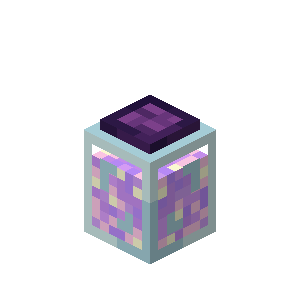 Media Interactions
I've made a discovery. Deposit Media, Withdraw Media, and (thing)Inner Media Purification work on not only Media Jars, but also Item Cradles as well. The only catches are that both cannot sustain any phianglements, and the Item Cradles must contain a media-containing item such as a Phial to function in this manner.
 Chariot
To fuse incompatible minds into an unsuitable vessel... Is it possible?
PresenceLately I've pondered a question--"Can I fuse two minds into one?"
I've given it much thought, and it seems the answer is YES. Combining it with Lapisworks, I may unlock machinations previously unimaginable.
 Amalgamations
While most villager minds can be used somehow in my Spell Circles, there are some types of villagers which have little to no place in them. For these I have devised an alternative: Amalgamations. By flaying a villager that is at least near it's maximum into a full simple mind, I can create these amalgamations, perversions of nature to the utmost degree, a meld of minds in tiny, unfit containers.
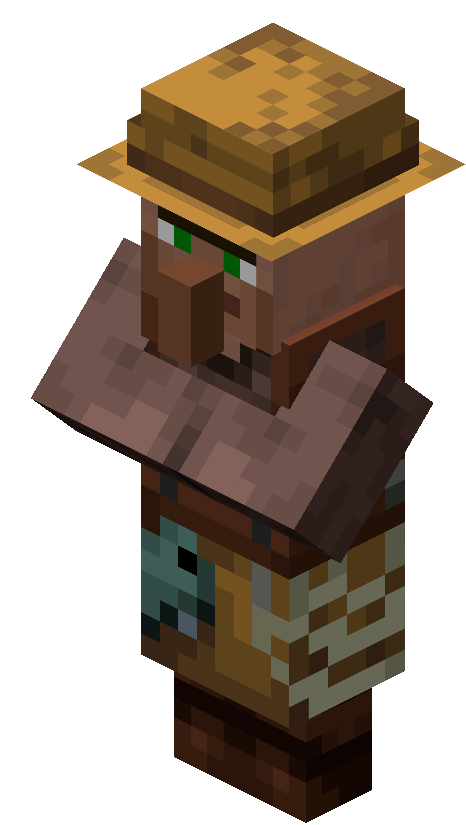
 Villager must be a Master Fisherman or higher
The result isn't two minds, but one singular mind in complete agony. Memories twisting and turning, two identities or one? I cannot imagine the suffering incurred, but don't need to. Their feeble lives are for my genius after all.
Villager must be a Journeyman Fisherman or higher
A lesser villager to make a simpler amalgamation. Differences explained on the next page.
Embedded amalgamations cast when they detect my entity reference be added to a stack within range. Complex ones (due to being formed by more experienced villagers) always detect this event and start the cast with a "guess" of where the event came from, guaranteed to be within a certain error range of the real position. Simple Amalgamations have a chance to cast (which depends on their error value) and have less maximum range but always start with the exact position of the offender.
Before imbuing the amalgamation into the Imbuement Bed I'm on (which may waste the amalgamation if a player is not on the bed) I must configure the amalgamation. To do this, I have been granted Amalgamation iotas, which are linked to their block of origin. All patterns concerning these are documented in the next pages.
Returns the Amalgamation in the container at the specified position (within range). Any changes to it are reflected in the block it came from.
Pushes whether the provided amalgamation is Complex (true) or Simple (false).
Loudness determines how much effort an amalgamation would put into alerting the person it's embedded in. 0 means the amalgamation would make no effort, 1 means the amalgamation would Reveals a warning to the person, 2 means the amalgamation would produce a sound as well, and 3 means the amalgamation would make text flash in front of the person's eyes for a few seconds.
Returns the Amalgamation in the container at the specified position (within range). Any changes to it are reflected in the block it came from.
Sets the provided amalgamation's loudness to the specified number (which must be positive and below 4).
Range determines the range at which the amalgamation can detect an offender. For Simple Amalgamations the maximum is 64 blocks, while for Complex Amalgamations the maximum is 256 blocks.
Sets the provided amalgamation's range to the specified number, mishapping if negative or out of bounds.
Embedded amalgamations are sorted by order of adding (so the first amalgamation to be added would be at the first index). When anyone in range adds my reference to their stack these amalgamations are cycled through and the first to successfully trigger's hex is activated. There can only be one execution attempt of an amalgamation per twentieth of a second, and I may only have three amalgamations at maximum.
Error is defined as range minus 32 then divided by eight ((r-32)/8) for simple and just range divided by four (r/4) for complex amalgamations. Error may never exceed 32. A hundred divided by err (100/err) is the percentage chance a Simple Amalgamation successfully triggers, while error is the range of innaccuracy of the guess a complex one provides.
Pushes the hex that the amalgamation at the top of the stack would execute upon a successful trigger.
Sets the hex that the provided amalgamation would execute upon a successful trigger.